
Long before there was a Sneha Karma Foundation, there was a hillside school in Assam, a handful of children who walked a long way to reach it, and one question I could not put down: why should a girl’s future depend on how far she has to walk?
A road I had not planned to take
My journey toward this work did not begin with a strategy document. It began with a month in a small classroom in Cusco, Peru, in 2011, teaching conversational English to people who needed it to earn a living. That trip planted a question I could not shake: what would it take for a person to be given a genuinely fair start? The following year, that question pulled me toward Assam, to a quiet place at the edge of the Garbhanga Reserve Forest, where I met children who would change the direction of my life.
What I found there was not a program. It was a man, a school, and a set of children from a forest village who were doing something extraordinary simply to stay in school. This is the story of my first visit to Garbhanga — the true origin of everything Sneha Karma Foundation would later become.
Parijat Academy: a school built on one man’s refusal
I arrived at Parijat Academy expecting an ordinary rural school. What I found was something closer to a family. Parijat was created by a kind-hearted philanthropist named Uttam Teron, who had taken on a challenge most people would have called impossible. He began by personally tutoring eight children from the forest village of Garbhanga — and then went further. He gave them not only lessons but food and a place to sleep. For all practical purposes, he had almost adopted these children and was raising them as a parent would.
That last detail is the one that stayed with me. It is one thing to run a school and teach a syllabus. It is another entirely to take responsibility for a child’s whole life — her meals, her safety, her health, her future — because no one else would. Uttamji had quietly decided that these children, far from the nearest town and far from most people’s attention, were worth that much. In a region where a girl is often the first to be pulled out of school, that refusal to give up on her was quietly radical.
The children from Garbhanga
During my stay, I was introduced to children from a village called Garbhanga, somewhere in the forest beyond the school. I was born and brought up in India, so the idea of children leaving a small village for a better education was not new to me. What surprised me was everything else about them.
These children woke before dawn and walked a considerable distance to school, and they attended their lessons with a seriousness I had rarely seen in any classroom. But they did more than study. They helped with the upkeep of the school, and they helped with the household work of Parijat Academy as well. They swept, they cleaned, they cooked. No one had to force them. They had understood something that children are not usually asked to understand so young: that the chance they had been given was fragile, and that it existed because someone had chosen to carry it for them.
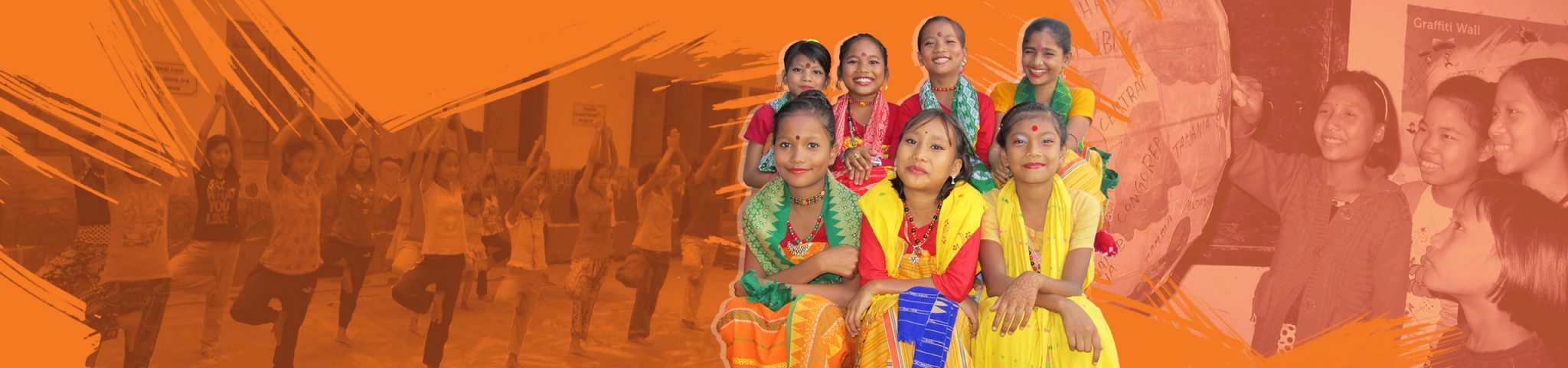
I did not once feel that these children from the forest village were outside Uttamji’s family. They were simply part of it. That sense of belonging — of being wanted, not merely enrolled — is the thing I would later try to build into every program Sneha Karma Foundation runs.
What I saw that changed my thinking
Before Garbhanga, I thought about charity in the way most people do: as a gift you give to someone who lacks something. Sitting with these children, I began to see the problem differently. The barrier in front of a girl here was not only money, though money was scarce. The barrier was distance — the long, unreliable, sometimes unsafe walk between a forest village and a classroom. It was the fact that the nearest school was too far for a small child, and that for a daughter, fear for her safety on that road became one more reason to keep her home.
I also saw the quiet arithmetic that families here are forced to do. When a household lives hand to mouth, every child costs something, and a daughter is too often seen as a cost rather than a future. If the walk is too long, or the family too poor, or the marriage too near, she simply stays home — not out of cruelty, but out of a scarcity that has taught everyone to ration hope.
And yet, right in front of me, was proof that this could be changed. Put a girl in a safe place to live and learn, give her meals and a bed and someone who believes in her, and she does not merely cope — she thrives. The children of Garbhanga were already the first in their families to read, to write, to imagine a life beyond the forest. All of it rested on one fragile foundation: someone had decided to keep them.
A seed, not yet a plan
I left Garbhanga without a plan, but with a conviction. If a single classroom, sustained by a single determined man, could change the life of a child from a forest village, then the problem was not that these girls were unreachable. The problem was that too few people had decided to reach them. That visit planted the seed of an idea: that a girl’s opportunity should never be capped by how far she lives from a road, or by the poverty or the gender bias she was born into.
It would take several more years — more visits, more listening, and a great deal of learning — before that idea took the shape of an organisation. Sneha Karma Foundation would be formally registered in the United States in 2015, and in India in 2022. But its true founding moment was not a date on a certificate. It was a morning in 2012, on a hillside in Assam, watching children from a forest village help sweep the school they loved.
The lesson I carried home
Looking back, my first visit to Garbhanga taught me three things that still guide our work today. First, proximity matters: real change begins when you go, sit down, and listen, rather than deciding from a distance what a community needs. Second, support must be whole: a bed, a meal, a safe place and a mentor matter as much as a classroom, because a girl who is unsafe or hungry cannot learn. And third, belief is the foundation: nothing we build for a girl will hold unless the people around her come to believe that she is worth it.
Everything Sneha Karma Foundation has done since — Support-A-Girl, the hostel for girls from these villages, Skills Development, our push for social change — grew out of what I glimpsed on that first trip. When we say we want every girl to have a fair start, we are not speaking abstractly. We are speaking about a specific hillside, a specific school, and specific children who showed us what is possible when someone simply refuses to look away.