For more than seven years, my colleagues at the VMware Foundation have quietly funded a mission that is not their own. This is a thank-you to them — and an honest look at what corporate giving, at its best, actually makes possible.
“Poverty is the worst form of violence”
Mahatma Gandhi called poverty the worst form of violence, and the longer we work in the forest villages of Assam, the more exactly that phrase fits. Poverty is not merely a lack of money. It is a slow, grinding force that decides who eats, who learns, who is married off as a child, and whose dreams quietly die for want of a fair chance. It is violence in the plainest sense: it takes years off a life and forecloses a future before it has begun.
When I joined VMware in 2014, I also became part of the VMware Foundation. In those first years I had far more time to give to it than I have been able to in the busy years since. But the VMware family never let me forget that I was still one of them. Time and again, colleagues who had every reason to think about their own lives instead chose to donate, steadily and generously, to Sneha Karma Foundation. This post is for them.
What corporate giving looks like when it is done well
There is a version of corporate social responsibility that is mostly a press release — a logo, a photo, a cheque. And then there is the version that actually changes lives: employees choosing, of their own accord, to give part of what they earn to a cause they believe in, backed by a company that makes that giving easy and meaningful.
That second version is what the VMware Foundation represents to us. It is sustained, personal and repeated. It does not arrive once and disappear. It shows up year after year, which is precisely what a mission like ours requires. Real change — keeping a girl in school from age eight to eighteen, training a woman until she earns her own income — is not a one-time transaction. It is a long commitment, and it needs supporters who stay.
The pandemic, and what your giving did
The pandemic tested everyone, and it tested the families we serve most of all. Lockdowns did not just inconvenience people here; they removed the ability to earn a living. With no savings, no work, and little children to feed, many families in Garbhanga faced hunger itself.
Thanks to the generosity of VMware colleagues and other supporters, Sneha Karma Foundation was able to provide rations to the villagers of Garbhanga — more than once — during the worst of the pandemic. It was not nearly enough. No relief effort ever is. But along with many other organisations who joined hands, we did our small part, and that part reached real families at the moment they had nowhere else to turn. For that, our gratitude is genuine and deep.
“Only a life lived for others is a life worthwhile.”
Albert Einstein
Physicist
What sustained corporate support actually funds
It is worth being concrete about what this kind of giving pays for, because the impact is easy to lose in the abstraction of a donation. Every recurring gift from a workplace community helps fund:
Girls who stay in school — tuition, uniforms, books and a nourishing midday meal, so that hunger never competes with learning.
A safe place to live and learn — accommodation for girls from villages too far to walk to school, one of the most common reasons a daughter is kept home.
Mentors beside each girl — trusted adults who work with families when pressure builds to withdraw or marry a girl early.
Skills that lead to income — vocational training and computer literacy that turn an education into employability.
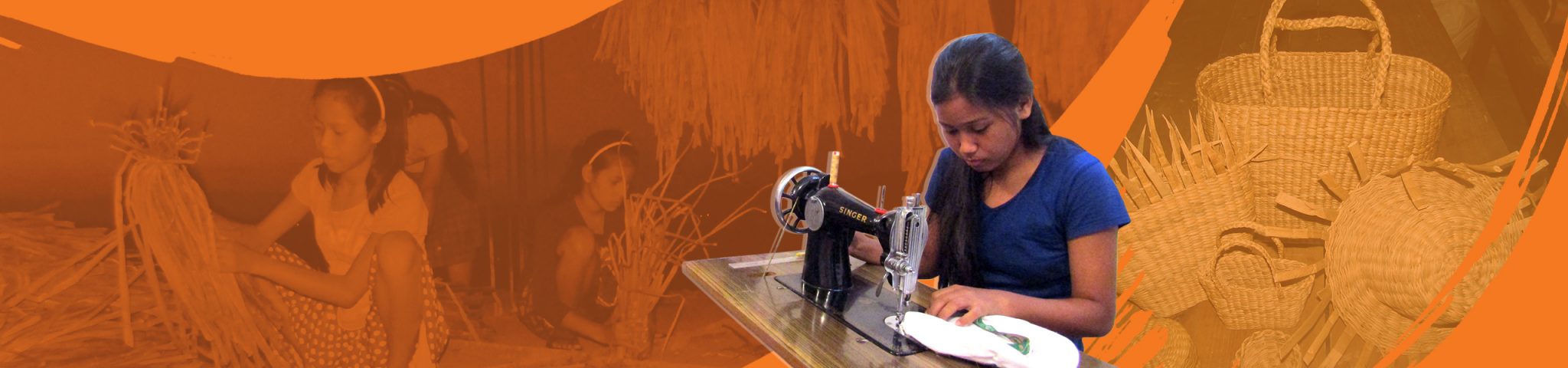
Livelihoods for women artisans — interest-free loans and fair marketplaces so that women who can make beautiful things can also earn from them.
Emergency responsiveness — the ability to act fast when floods or a pandemic threaten the families we serve.
“When you educate a woman, you educate a nation.”
African proverb
Why companies should care — beyond compliance
For companies in India, CSR is no longer optional; it is a legal and ethical expectation. But the deeper case for corporate giving has nothing to do with compliance. It is that a company is a community of people, and when those people are given an easy, trusted way to turn their good fortune into someone else’s good fortune, remarkable things happen. Employees feel connected to something larger than the quarterly result. The company earns a kind of trust that no marketing budget can buy. And families thousands of miles away get a chance they would otherwise never have.
We have seen what moves the needle. Matching gifts, where a company doubles an employee’s donation, greatly multiply the impact. Employee giving campaigns bring colleagues together around a shared purpose. And program sponsorship allows a company to fund something specific and see it through — a cohort of girls, a training centre, a year of mentors. Each is a form of partnership, and each is welcome.
If you would like to join
To my friends at VMware who have carried this mission with us for the better part of a decade: thank you, from the bottom of my heart. You have kept girls in school, trained women who now earn with dignity, and fed families through the worst year many of them have ever known. Your generosity has been quiet, consistent and transformative.
A small ask that multiplies
If you take one practical thing from this post, let it be this: ask whether your employer matches your giving. A matching gift is the simplest way to double the effect of a donation without reaching deeper into your own pocket. Runs, workplace campaigns and peer fundraisers do the same thing in a different way, by turning one person’s generosity into a small community’s. None of it requires great wealth. It requires only that people who have a little choose to share a little, consistently, in a way that adds up. That is exactly how the VMware community has supported girls in Assam for years — not through any single grand gesture, but through many quiet, repeated ones.
And to anyone reading this who works somewhere that values giving: there is a place for you in this work. Whether through a matching programme, a team campaign or a single recurring gift, you can help decide whether a girl in a forest village finishes her education or is married before she is grown. We would be proud to have you join us. The girls who benefit will never know your name — but they will live the life your generosity made possible.